Hi everyone! My name is Yana Prokofieva – I'm the CEO of HR agency RED, a psychologist, and head of the humanities track for business programs at Moscow State University (MSU).
In my work, I often deal with building teams, and I want to share some observations with you.
In this article, I explain how to build a truly effective team, what challenges you might run into, and how to overcome them.
Today, a team isn't just a group of people – it's the key to business success. Working in sync helps you solve problems faster and more effectively, uncover new opportunities, and move the company forward. A strong, well-built team helps you look at a problem from different angles, pool skills and experience toward a shared goal, and lets team members grow and develop by learning from one another and from their leader.
When we picture people brought together by a shared line of work, we often think of a work group. It's important to distinguish between a team and a work group, since they typically handle different kinds of projects, solve different kinds of problems, and function in different ways. The image below outlines the main differences between a team and a work group.
| Team | Work Group |
| Complex projects | Simple projects |
| Everyone shares responsibility | All responsibility rests with the leader |
| A group of people whose skills complement each other | Each person in the group carries out their own individual task |
| Creativity, innovation | Mechanical execution of what the leader says |
| Roles assigned based on individual strengths | Performing assigned job duties |
| Inspired by and engaged with a shared mission | No clear understanding of the purpose behind the tasks |
An important factor in building a team is the optimal number of members: 7 ± 2 (5 to 9 people) – this isn't just an arbitrary figure, but the result of research in psychology, cognitive science, and management, known as Miller's number.
More About Miller's Number
In 1956, psychologist George Miller demonstrated that human short-term memory can hold 5 to 9 pieces of information at the same time.
- In a team of 5 to 9 people, everyone can interact directly, without complicated hierarchies.
- If there are more members, the number of connections grows exponentially:
5 people: 10 connections
9 people: 36 connections
12 people: a full 66 connections!
- Fewer than 5 people – risk of missing skill sets, bottlenecks, and a shortage of ideas.
- More than 9 people – harder to manage, with role duplication and "social loafing," where someone starts coasting.
If a team has more than 9 members, it's worth splitting it into subgroups to improve effectiveness.
Challenges of Working in a Team
Working in a team certainly offers plenty of advantages, but like any other form of collaboration, it's not without its difficulties. Understanding these challenges is the first step toward overcoming them effectively. After all, a team succeeds not when everyone in it works flawlessly, but when it's able to handle problems and adapt to change.
Challenge 1: Group Interaction
Interaction is a core element of any team. At the same time, the more members a group has, the more effort it takes to maintain quality communication:
- Slower decision-making: Group discussions often take longer than individual decisions. This can sometimes lead to delays in the workflow.
- Risk of miscommunication: Different communication styles, cross-cultural differences, or simply a lack of clarity in conversations can lead to conflicts and mistakes.
- Coordination challenges: Assigning roles and tasks and tracking work progress all require significant organizational effort.
Solution
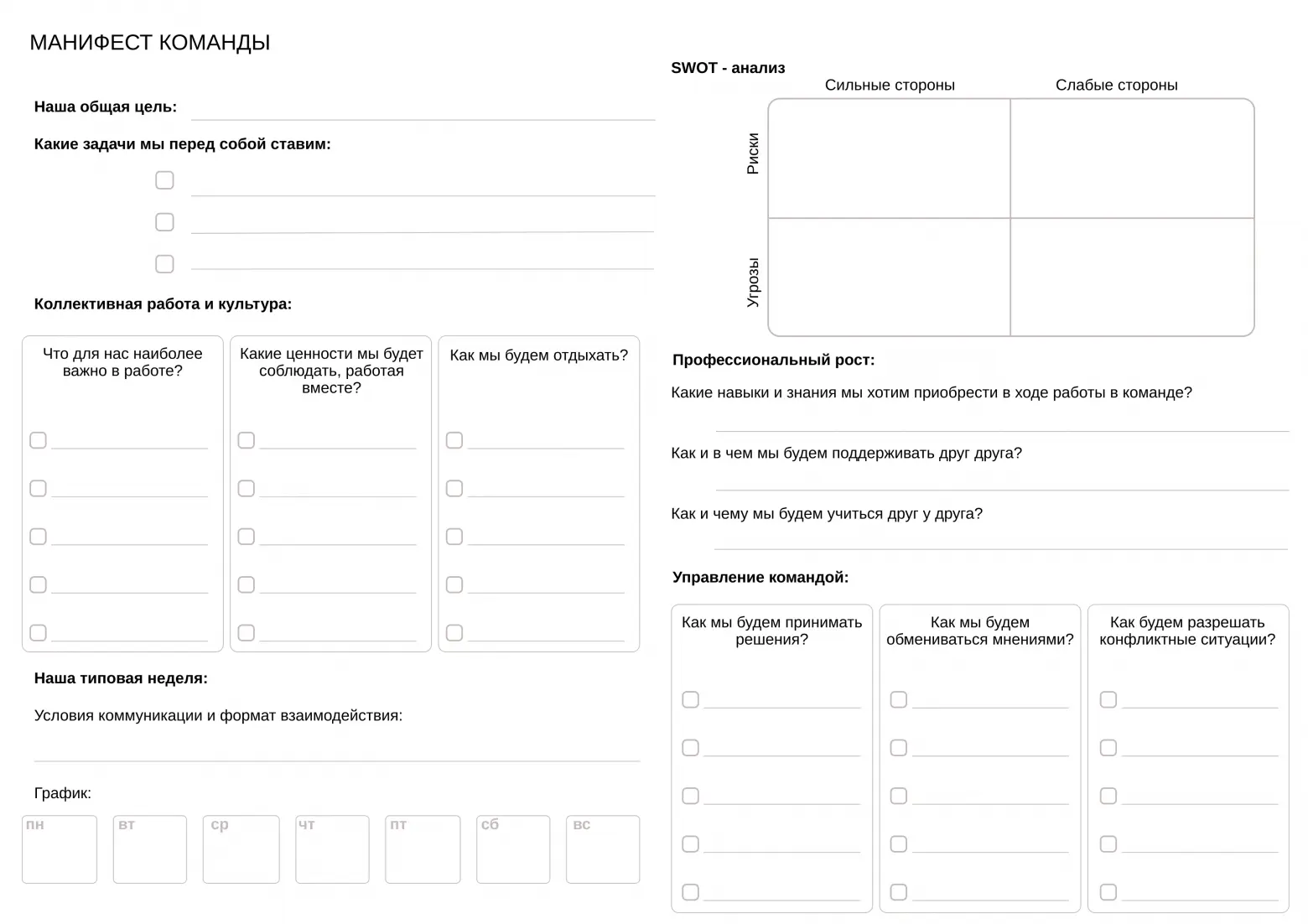
You can ease the communication burden by setting shared agreements and guidelines within the team. I've been through this process myself, analyzed the experience, and put together a manifesto that will make your team's interactions simpler and more effective.
How do you fill out the manifesto?
- Bring the whole team together for a discussion – this will help you work out norms that everyone is willing to stand behind.
- Write the manifesto down and make it accessible to everyone (print it out or save it somewhere shared).
- Revisit the agreements regularly so they keep pace with new tasks and conditions.
Challenge 2: Bigger Group, Lower Efficiency
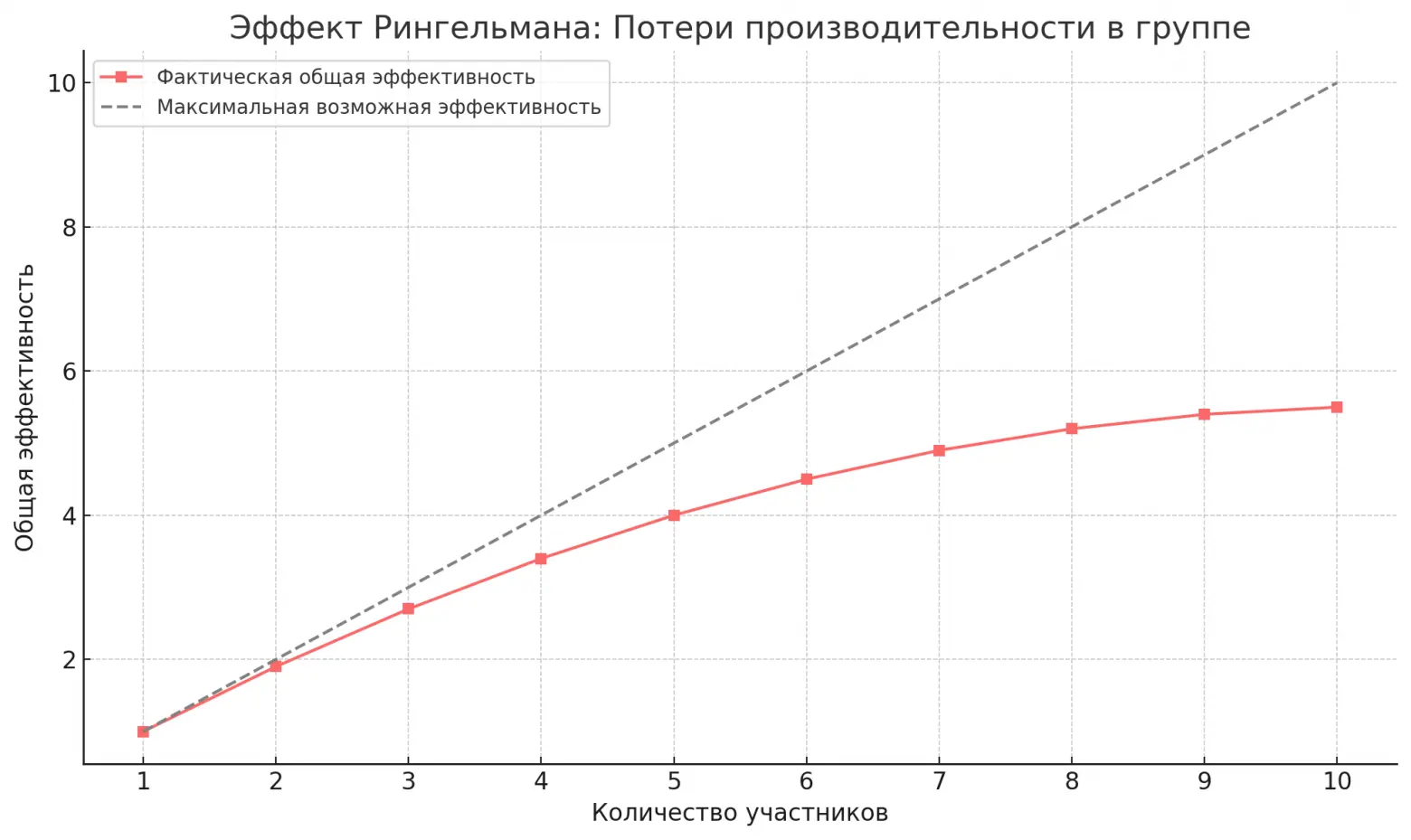
Another common problem in teams is the Ringelmann effect, where an individual's productivity drops within a group. The reason? Members may, consciously or not, put in less effort, assuming that others will be responsible for the outcome anyway.
More about the Ringelmann effect
The research was conducted by French engineer and agronomist Max Ringelmann in 1913.
In his experiment, he studied people's effort during a tug-of-war:
- One person pulled with maximum force.
- Then more participants were added, and they pulled the rope together.
- The expectation was that their efforts would add up – but that's not what happened.
| Number of People in the Group | Total Group Effort (% of theoretical maximum) | Individual Effort (% of one person's maximum) |
| 1 person | 100% | 100% |
| 2 people | ~186% | ~93% |
| 3 people | ~255% | ~85% |
| 4 people | ~316% | ~79% |
| 5 people | ~375% | ~75% |
| 6 people | ~432% | ~72% |
| 7 people | ~485% | ~69% |
| 8 people | ~549% | ~61% |
Solution
To reduce the impact of the Ringelmann effect, it's worth paying attention to the following:
- Process transparency: It's important for team members to understand not just their own tasks, but what their colleagues are working on too.
- Accountability: Every team member should feel personally responsible for the overall outcome.
- Recognizing contribution: Regularly evaluate progress so team members see their efforts acknowledged.
Challenge 3: Balancing Strategy and Day-to-Day Routine
In a traditional team structure, there's usually a single designated leader. But when it comes to building a truly effective team, it becomes clear that one leader isn't enough. That's because they end up torn between strategic vision and day-to-day operations. This heavy workload inevitably leads to a loss of focus: either the strategy suffers, or the operational tasks do.
Solution
The leadership role needs to be split. A strong team always has two types of leaders: one focuses on the big picture and the vision for the outcome, while the other takes responsibility for the process of getting there.

I've put together a comparison table that clearly shows the differences between the two types of leadership across four key parameters. It will help you easily understand the specifics of each role and see how they complement one another.
| Parameter | Goal-Oriented Leader | Process-Oriented Leader |
| Focus | On results | On interaction |
| Role | Directive / guiding | Supportive / facilitating |
| Influence | Through goals and motivation | Through climate and culture |
| Risks if unbalanced | Authoritarianism, burnout | Loss of focus, dragged-out tasks |
Both roles are fundamentally important. The ideal scenario is one where a team has both types of leaders present. It's precisely the balance between a focus on tasks and building solid processes that forms the foundation for a strong, resilient team.
This article covers only some of the challenges you might run into when building and working in a team. That said, I sincerely hope my insights become a useful tool for you in building a strong, effective team capable of achieving ambitious goals and rising to any challenge.
RECRUITMENT AGENCY

10 Andropova Avenue, Office 4015,
Moscow, Russia, 115432
Media Center
Privacy Policy
Public Offer Agreement
Design by
MADEON
Developed by
Alexander Borisov
RED 2026 © All Rights Reserved